
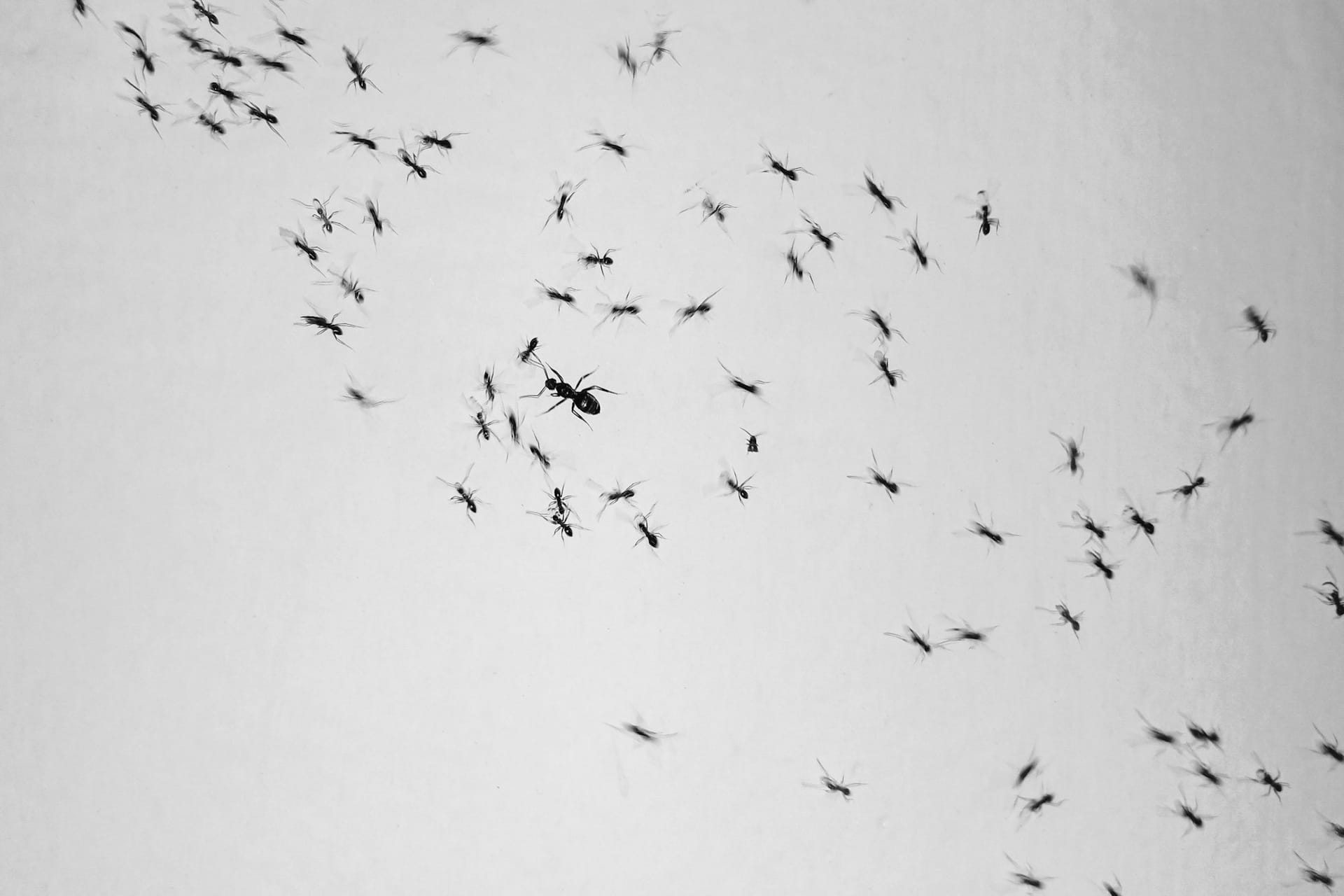
I'm writing you this letter with some timidity, though not so much that I won't send it. I'm writing it to you seated at my dining room table, in a tropical city where the ants haven't gotten the memo about urban development. Here they keep marching as if they were crossing through the jungle, with the same persistence and in the same numbers. On this very table, Dr. Hartley, there's a small line of ants that I'm watching with suspicion as I write you this letter, inappropriate for an intellectual of your stature.
What I want to tell you is that a stranger is writing to you. Not only in the sense that we don't know each other, we've never been properly introduced. Also in the sense that you might find me strange, though I don't want to prejudice you. We'll get to the evaluation part later. For now you should know that our only tenuous connection is that I'm one of your followers on social media. There I read your articles and your perfectly well-formed political opinions, and some of your everyday life adventures. I know you have a wife named Sarah, a GP, about whom you speak very little. You refer to her only obliquely. I also know you have children who are now adults, a daughter who works at an NGO and a son who does one of those indecipherable jobs in tech. I know you have a cat named Tito, who sometimes appears in photos bathed in afternoon light on your perfectly messy desk. This desk sometimes makes an appearance in the background of a television interview looking much cleaner, with some books strategically placed in the back, and several of those Moleskine notebooks where you insist on writing your drafts by hand. I imagine you've had this habit since you personally lived through the fall of the Soviet Union, or from the time you spent in Belgrade during the escalation of tensions that opened the nineties.
Clearly you're a curious person, a man of ideas, someone who reads and writes. You're the author of several important books on Russian nuclear doctrine and nuclear deterrence theory. Your books are full of historical and theoretical references that I've read and annotated carefully, though I haven't managed to understand them all. I've also watched several of your talks at different forums, now available on video on the Internet. I don't know if you've noticed, Dr. Hartley, but over the years you still tend to play with your wedding ring, turning it when you get nervous. Just last night I fell asleep listening to an interview from a few months ago, happier times, in which a young man asks you things about the conflict between Russia and Ukraine that you evidently consider very basic, trivial, without mystery. I laugh a little to myself, Dr. Hartley, thinking what you were thinking: this kid needs to read more. Especially "The Red Button: Nuclear Brinkmanship from Cuba to Crimea," which you published almost twenty-five years ago. But more than that, he needs to live the life you lived, these decades of fighting in the violent trenches of academia, of policy advising, of public life. This kid is probably the age of one of your children and you can't help but see him with some tenderness. He didn't have to live through the history that appears in books—for him, everything is unknown.
Dr. Hartley, I don't mean to interrupt this letter, but the ants are climbing onto a plate with the remains of a toast with butter and pineapple jelly left over from breakfast. Here you can't leave that like that, you have to clean everything immediately. I wonder who cleans up the remains of your breakfast. I'm sure it's you yourself, and not Sarah, because you're reasonably feminist and she has a very important job. Maybe it's her, because you're busy thinking about very intricate things about governments and countries, matters of global power and economic expansion, arms sales and refugee crises. She perhaps passes silently by your desk and picks up your plate with toast, so the ants won't climb on it. That's not your problem, of course, but I'm attempting here a metaphor about the deterioration of things. I'm my own oblique wife, so I have to get up and solve this before myrmecological chaos breaks out.
Done. Where was I? Oh yes. You might think that this unknown woman, perhaps a bit unbalanced, is obsessed with you. That she's accumulated too many details about your private life (you'd be surprised how available all this is). This improbable woman also lives in a peripheral country, made irrelevant by its GDP and its almost nonexistent role in the political events that have shaped the region since colonial times, totally outside your area of expertise. I hope that gives you some peace of mind—it's not like one day I'm going to show up outside your office at King's College in London and give you a box full of ants. Don't worry, that's never been my intention. What I want from you is very simple.
Today I saw an interview of yours on the British news channel, because Russia announced it was withdrawing from the verification protocols of the New START treaty. Furthermore, the Germans say their intelligence knows they've been moving nuclear weapons to Kaliningrad. In this interview you said we're in the most dangerous nuclear environment since the Cuban Missile Crisis. So, Dr. Hartley, I decided to write you this letter to ask you a question: more or less what day and at what time can I give up?
I want to know when the men who have their finger on the deadly button of history are going to lower it, and a series of worries will end to begin other much more existential ones, perhaps smaller ones. Not because I have many pending items (I think I've already done almost everything I had to do), but I want to make sure I die in the first wave of whatever's coming. I know that in my tropical case I won't suffer the immediate terror of a cloud of toxic material traveling through the air, but rather an economic or food crisis that will probably finish us off.
I don't want to survive a minute longer than necessary, I don't want to witness humanity's monumental tragedy. I want to put on my sandals, go down two floors to street level, walk to the neighborhood mini-market, buy myself a pack of cigarettes, never again pick up a dirty plate with any kind of urgency. I know that thinking about the end of the world is an anachronism, but I also know you'll understand me—after all, we both grew up on the same side of history, with an intuition of a complete and imminent ending, in which the ants will outlive us. Please don't tell me it's complex, that there are processes, that chains of events and consequences are unleashed. I ask you to spare me the details. I'll settle for an approximate range of dates to lose my mind, to go back to living as if there were no future. Thank you very much.