
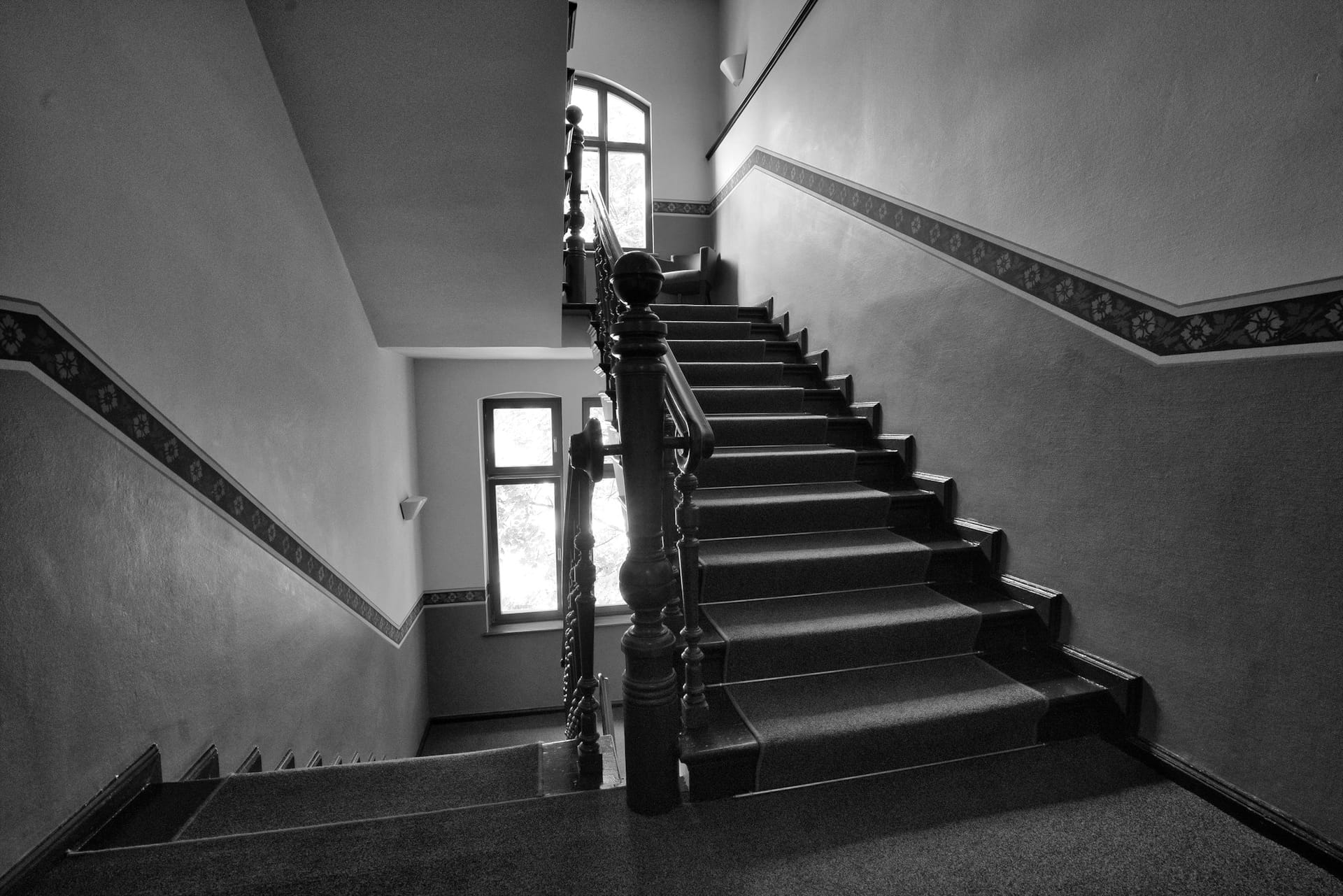
I am writing to you from the second floor up to the third. If I ever dare, I would have to bring you this letter folded in an envelope and slip it under your door, with no need to sign it. We are neighbors; you already know who I am. I live on the floor directly below the one where you have lived for three years.
Your sister helped you move in — I understand that now. I heard it early, the feet of your nephews on the ceiling, running with the excitement that comes with a move. I thought perhaps they were yours, that we would have children in the building, that I would have to worry about this mad noise every day. My instincts as a disagreeable old woman went on alert. But at the end of the day they left, and the two of us were alone again in the silence. They come back, from time to time, to visit you on weekends. I wonder whether you want children yourself, Lucía. It is a very bold question, an odious one, the kind that gets me into trouble.
I had a little girl once, Clarita, who ran and made monstrous noise that the neighbours complained about. She loved to dance — she danced across the living room floor and into the kitchen, leaping about. The neighbour downstairs would spend his evenings banging on his ceiling with a broomstick when it got late, the two of us jumping in the living room, carried away by the music, and then the party would be over. That was many years ago. The neighbour with the broomstick died alone in his apartment, just as I imagine I will die in mine.
Shortly after you moved in, we met in the lobby. We introduced ourselves. You told me your cat's name was Enrique, which struck me as terrible. It is not good taste to give a cat a person's name. But in any case, Enrique found some way to get into my apartment through the little back balcony, which is connected to yours by a small cement ledge. That is how Enrique comes down, ungovernable. On the afternoons when you are at work, he comes to keep me company while I work at my old desk. He likes the warmth and the hum of my computer fan. I find his yellow hairs everywhere now. From my little sitting room I have worked in accounting from home, for several small companies, since Clara was in third grade. Back then she was mad about animals, she always wanted us to have a little dog or a cat, but I was far stricter in those days — I was frightened all the time, trying to be an adequate single mother, more or less normal.
A few months after you arrived, Javier began coming by — Javier, I think his name was. I heard you calling him up the stairwell as he went down, having forgotten something. He came to see you for months, and I thought he would stay. You thought so too, no doubt. One never knows. During those months I was very careful; I did not want to hear more than was my share to hear. Lucía: I confess that I too have had lovers. When I was young I was involved with several men who never quite suited me because they were not serious. They were ordinary young men, I know that now, but they were not enough for me. I had one who was more than enough — handsome, impressive — but he did not stay either, because he was married to someone else. Clara's father. When it was clear he would never leave his wife for us, for any reason at all, he left us settled in this apartment and disappeared. Since Clara left I have had one or two, spread far apart across the years. I have always stopped seeing them with urgency, with relief.
I think Javier was not so important, because not long after you were looking better again. Your music was modern again, cheerful. You had some wild parties with your friends, who are loud and come from other countries and smoke on the balcony. I do not complain, Lucía — I have infinite patience for parties now. In another era I might have reached for the broomstick. But when the other neighbours mention them I insist I cannot hear a thing, that they do not bother me, that my sleeping pills are more powerful than any commotion among girls. I imagine Clarita as one of your friends, leaping about again, the two of you girls together once more. But of course, she is nothing like you, nothing like your friends. She is not like anyone.
It is easy to say I did the best I could. That I never knew what I did that was so unforgivable, never understood what I was being held to account for. But that is not true. I was ashamed of my daughter, Lucía. I found her ugly, unkempt, mannish. She would cut her own hair in the bathroom when I was not watching, and she always looked a fright. She came home from school with her uniform a wreck, with scrapes on her knees, with a permanent stripe of dirt under her nails. I was hard on her, of course. I grew up with a very fixed idea of how girls were supposed to be. I tried to wash it all away with soap; I tried to scrub her personality out with a stiff brush.
I have always wanted to ask you — where is your mother, Lucía? Perhaps mothers simply think we matter more than we do, in the end. My mother died when I was a teenager, and though I remember less and less of her, I miss her terribly. The little she left me was a strict adherence to the rules, to what was proper, to not being a bother to others. I spent my life trying not to get in the way, stepping aside for everyone. I never would have thrown a party for my friends, never would have lived alone, never would have dared so much. I think the boldest thing I ever did was have Clara — a daughter who left, and who is also as though she had died, or as though I had died.
I write you this letter because I want to say things to her and I cannot. Because every time I tried, every time I wanted to raise the white flag, on the other side there was only silence. I suppose that is how all ruptures go: one is not the one who decides whether the other person wants to be there for you. I was taught that you owed something to the person who brought you into the world. That no matter how terrible she was, you would always owe her some word, some form of forgiveness. But I know now that it is not so. That it is possible for her to be free of me, of my rigidity and my limits. All that is left to me now is patience — the accounts for this fiscal year, Enrique coming in through the balcony, a little drop of milk set out for him.
Lucía, I do not want us to become friends, or for you to pity me, or to come and visit. I only hope you do not leave too soon, because I want to keep listening to you be free. To see if I can learn something, even if by the time I do I am old, shut in, disagreeable, unknown to others. I want time to be a witness to your life as an ordinary, imperfect young woman. What I want is another chance.